AI4Padel or WhatsApp broadcast groups?
When a club manager compares tools, they look at other software. But most courts in Spain are not filled by software: they are filled by the club WhatsApp group, the broadcast list and your memory. Group or list, here we just call it “the group”. That is AI4Padel’s real competitor, and it deserves the same honest comparison we gave the rest of the tools.
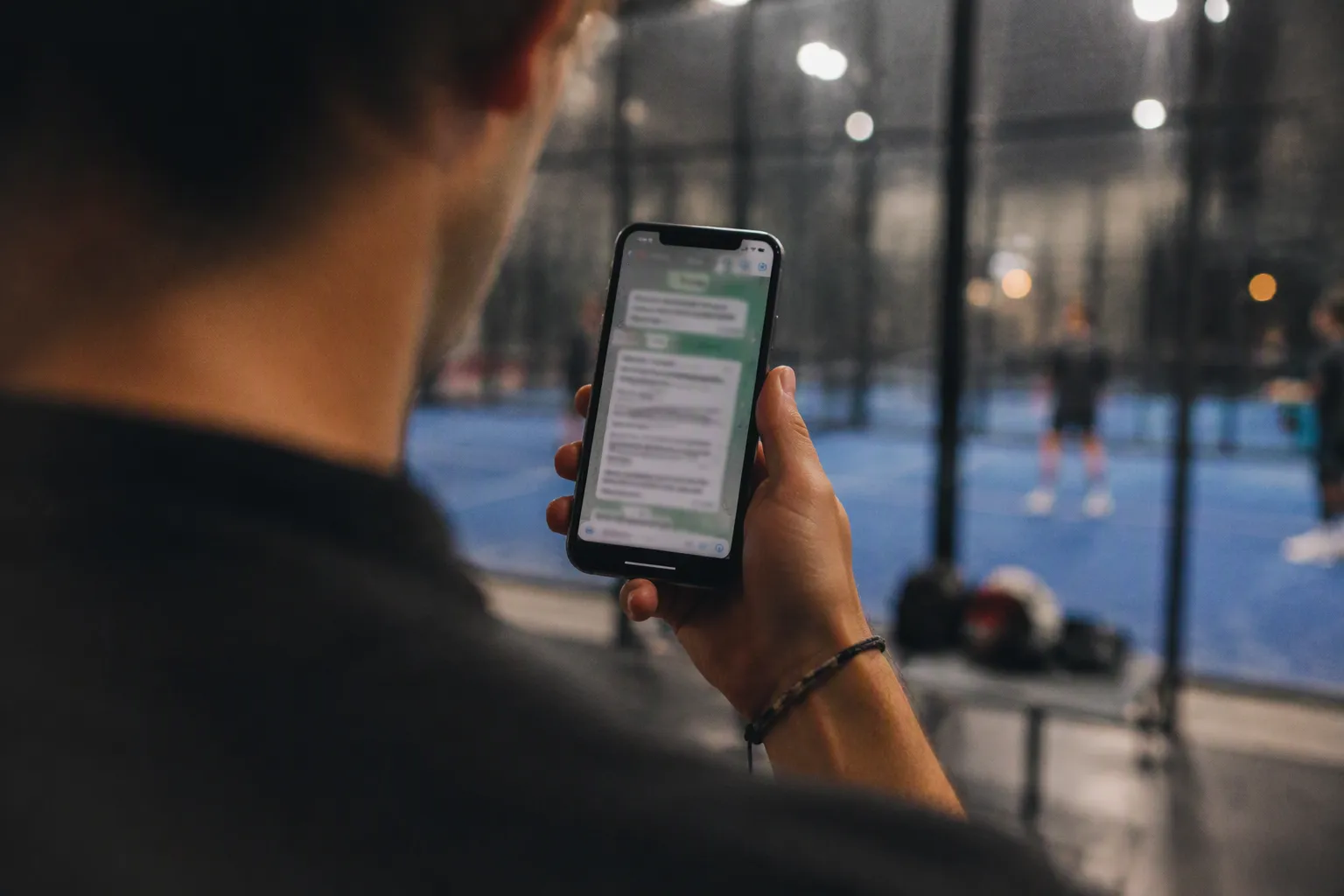
The lifelong method: the group, the gap, and hoping the right one replies.
What the group does well
Let’s start by admitting it, because it is true: the group is free, there is nothing to install, your players are already in it and one message reaches eighty people in a second. For the club’s social life it is unbeatable: Saturday’s highlight video, the jokes, the tournament draw. None of that should ever leave.
At 40 players and two courts, the group fills courts too. You know everyone’s level, gaps are few and your afternoon covers the chasing. The channel works fine. It stops working when the club grows.
The five problems with the group
1. The seat goes to the first to reply
The group doesn’t choose: it sorts by speed. And the first to reply is almost never the one who fits: it’s whoever was looking at their phone. If their level sits two steps below the other three, the match comes out lopsided. A lopsided match burns all four at once, and those four take weeks to sign up again.
2. Your half hour per gap
Write the message, wait, answer questions (“what level is the match?”, “what time was it?”), cross out the one who bails, ask again. Multiply it by a week’s worth of gaps and that is your afternoon. A 90-minute court that falls through anyway is more than €24 that never comes back (Spanish average, Global Padel Report 2025); the time you spent chasing it, nobody refunds.
3. You disturb eighty to seat one
Every gap is a message to the whole group. The people who can’t play learn to ignore your messages, and the day you post something important, nobody reads that either. The broadcast list delivers the same noise, just in private.
4. The delicate stuff happens in public
The last-minute dropout, the “who’s missing?” that reads like a reproach, the player nobody answers. In the group, every errand has an audience. Some club conversations, a pending payment, a complaint, a “count me out this season”, should never happen in front of eighty people.
5. Nothing is kept anywhere
Who accepted last time? Who never replies? Who did Marta play well with? Today all of that lives in your head, and it does not scale to 400 players. When the person who runs the group goes on holiday, the club loses its memory.
The group vs AI4Padel
| The club group | AI4Padel | |
|---|---|---|
| Who takes the seat | The first to reply | Whoever fits, with the written reason |
| Your time per gap | The usual half hour | Pick from the list and press «Enviar invitación» |
| Who gets disturbed | All eighty in the group | Only those who fit, one to one |
| Confirmations | You chase them, one by one | One click per player: confirmation and reminder already written |
| What gets recorded | Nothing: memory and scroll | Each player’s card: real slots, who they play with, how many invitations they accept |
| The delicate stuff | In public | In private, one to one, from the club’s WhatsApp |
| The cost | Free today, very expensive next month | Flat price per club, no commissions |
How that “whoever fits” gets picked, with the criteria open to argue, is told in every name with its why.
The channel is still WhatsApp
There is nobody to convince to switch apps here. You are the one using AI4Padel, not your player. They get a message from the club’s number, in your tone and your words, and reply “yes” the way they replied in the group. They install nothing, create no account, never notice the tool.
In fact, the messages still leave literally from your WhatsApp: AI4Padel leaves you who to write to and what to say, you press «Enviar invitación» (send invitation), the club’s WhatsApp opens with the message in place and you send it. That may sound like we have gone back to the group, and it is precisely the opposite. The difference was never who hits send: it is who decides who gets written to and what they are told. The group is a loudspeaker that reaches eighty at once; this is a message written for one specific person, picked on level, position, hour and history. What each of those two things costs is in euros here.
What changes is who does the thinking. You see the gaps on Inicio, the home screen, it proposes the names with the reason next to each one, the message comes from your templates, and you note each reply with one click, so you always know who still owes you an answer. The house rule doesn’t change with the channel: you decide what gets sent.
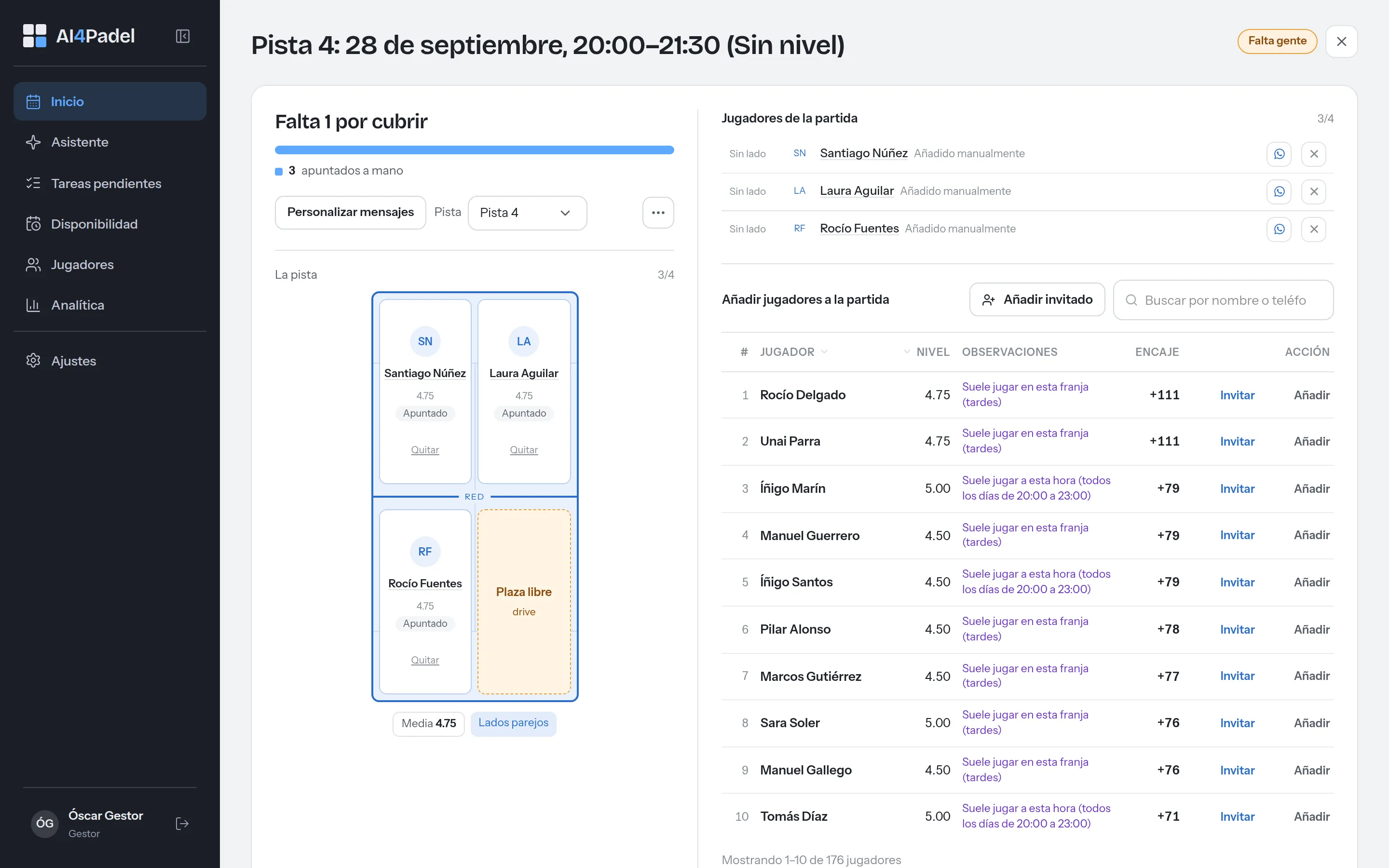
A match one player short: the three already in, each with their WhatsApp one click away, and below who to invite, one by one and with their reason.
What used to happen in front of everyone in the group happens here in private, on the record: three messages to three people, instead of one to eighty. And a last-minute dropout gets recorded without an announcement: taking someone out of a match tells nobody anything, and who to tell is your call.
The group keeps the social life
We are not here to kill the club group: it just stops being your management system. The group keeps what it does brilliantly, the social life, and the operations, gaps, confirmations, dropouts, win-backs, move to a one-to-one channel that disturbs nobody and doesn’t depend on your memory.
The player who played every week and hasn’t shown up in a month will not surface in the group: there you only see the people who talk. In AI4Padel they show up in the list of players who fit with «Sin partida desde hace 21 días», no match in 21 days, and the analytics add the full list of the ones going cold. A weekly player is worth around €300 a year (one match a week, about €6 per player): one going cold without anyone writing costs you more than any single gap.
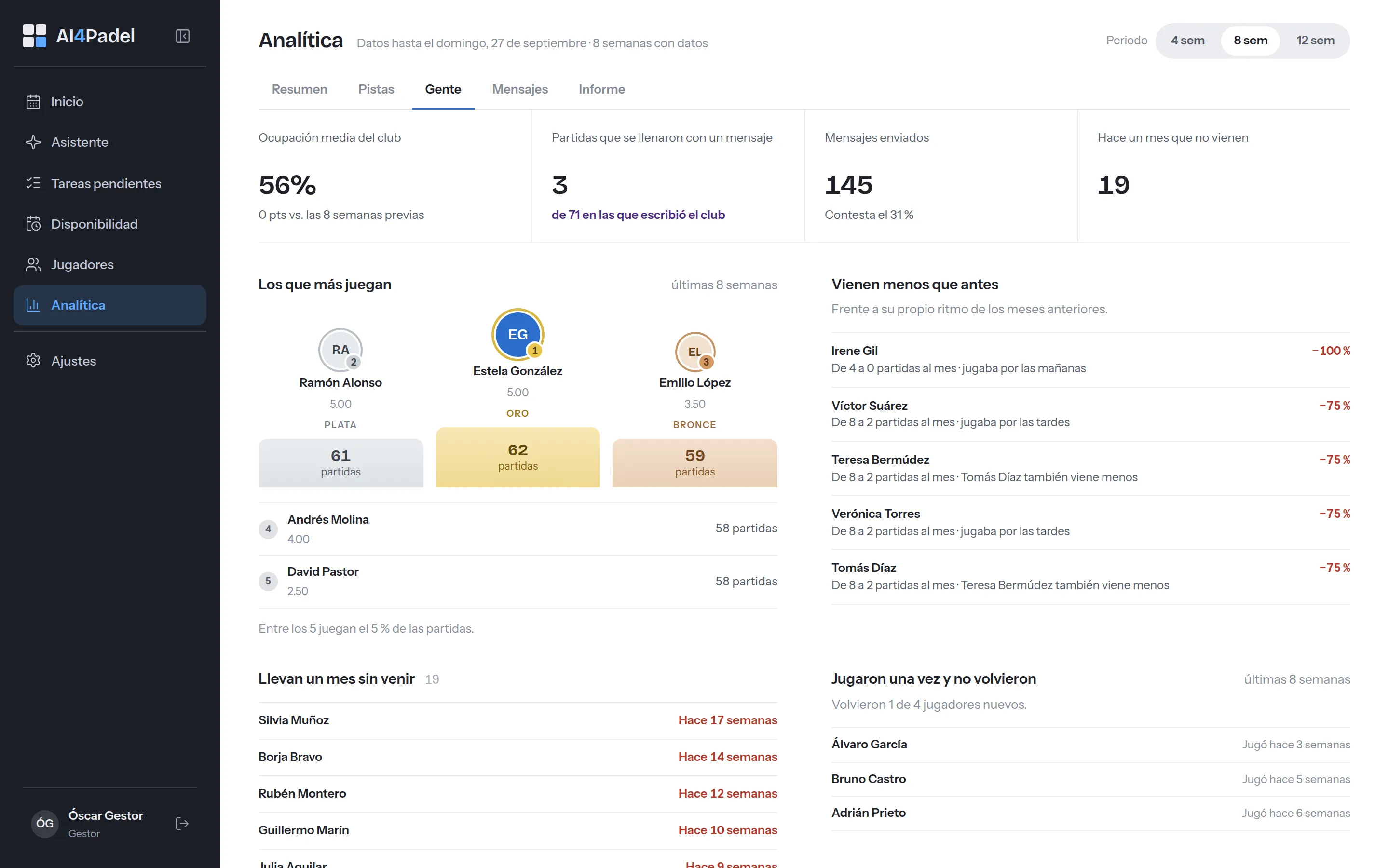
Analytics, People tab: the most active players, «Llevan un mes sin venir» (a month without coming) and «Jugaron una vez y no volvieron» (played once, never came back). What the group never shows you.
When should you stick to the group alone?
Same honest yardstick as always: with two courts, forty players and a free afternoon, the group is plenty and you don’t need us. Keep this page for when the club grows and the gaps stop fitting in your half hour.
How many gaps did your group close this week, and what did they cost you? Book a 15-minute demo and we’ll do the maths on your real schedule.