How AI4Padel decides who to invite
When a match is one player short, the most common method in clubs is the fastest one: a message to the group, and the first to reply gets in. The problem is that the first to reply is almost never the one who fits: it’s whoever happened to be looking at their phone. If their level is far from the other three, the match comes out lopsided. And a lopsided match burns all four at once: the strong one gets bored, the ones out of their depth get frustrated, and all four think twice before signing up again.
AI4Padel uses a different method: every name it proposes carries its reason, written right next to it. This is what it looks like on screen:
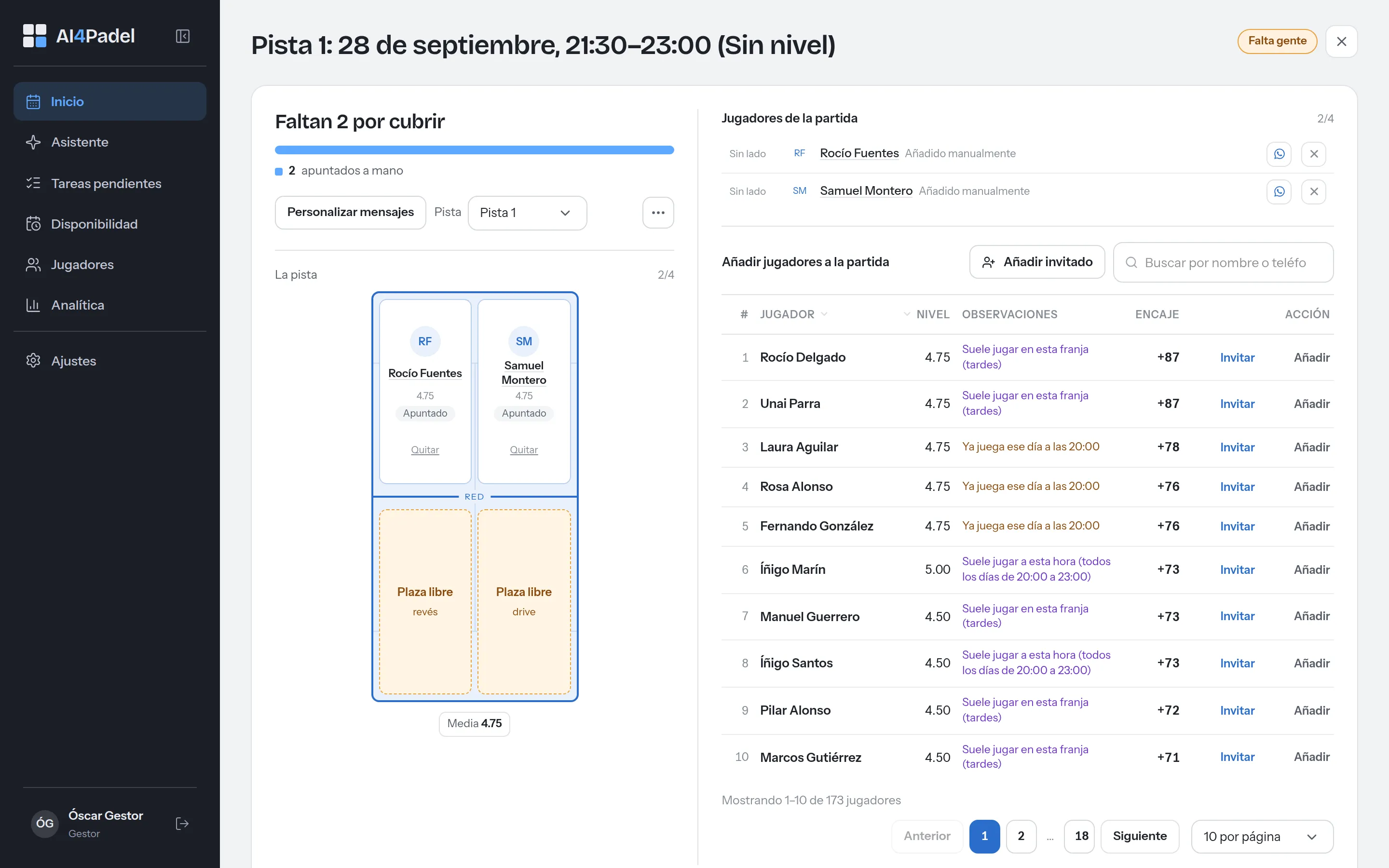
The 21:30 match on Court 1, two players short: the candidates in order of fit, each one’s why and, on every row, «Invitar» (invite) or «Añadir» (add). The product runs in Spanish; quotes below come with a translation.
What it checks before proposing a name
- The level, and where it came from. A level the club set after watching someone play, one that came from Matchpoint or your spreadsheet, and an estimated one don’t deserve the same trust. So the player card always states the origin, and when nobody has confirmed a level, the reason says so: «Nivel estimado, sin confirmar por el club», estimated level, not confirmed by the club. You know how much to lean on it before deciding.
- Court side, and the balance of the four. Right side or left side, and how the match shapes up pair against pair. It’s not enough for each player to be good on their own: the four together have to make an even match. The court drawn on the match shows it: the average level and, when it works out, «Lados parejos», even sides.
- The hours they actually play. What a player declared when signing up is one thing; when they actually step on court is another. The demo club has a textbook case: Adrián’s card says weekdays from 12:00 to 15:00, and 90 % of his matches are in the afternoon. To fill an afternoon slot, the second one matters more.
- Who they already play with. If they’ve shared a court with someone already in the match, it says so: «Ha jugado 3 veces con Daniela», has played with Daniela three times. Mixes that keep repeating tend to be the ones that work.
- How much they play, and whether it’s dropping. «Juega con frecuencia alta», plays often, moves up the list; «Está jugando menos que antes», playing less than before, is said too.
- How often they say yes. Whoever tends to accept gets asked before whoever never replies: «Suele aceptar las invitaciones (80 %)», usually accepts invitations. It comes from the answers you note down. Your time counts too.
- How long since their last match. A player who has been off court for a couple of weeks gets a small push up the list: inviting them fills today’s gap and keeps them from drifting away. A weekly player is worth around 300 € a year (one match a week at about 6 € per player): don’t let one slip without at least trying.
Every name with its reason
No magic list. Next to each name there is a plain sentence, like these:
- «Nivel 2.25, compatible con la partida (1.50 – 2.75)»: level 2.25, compatible with this match. Their level against the real range of the players already in, not against a generic label.
- «Juega con frecuencia alta»: plays often. What their matches say.
- «Sin partida desde hace 21 días»: no match in 21 days. The push for the one who has been off court a while.
- «Nivel algo inferior (2.00), compensable en pareja»: slightly lower level, workable with the right partner. When something isn’t perfect, it says so.
And when someone doesn’t quite fit, it says that too: in the demo club’s 3:30pm match, Cristina shows up with «Nivel por encima de la partida (3.00)», a level above this match. And if someone already has a match that day, it warns you: «ya juega ese día a las 23:30», already playing at 11:30pm that day. These are warnings, not vetoes: you can still invite them. It’s your club.
Invite or add, and you send the WhatsApp
For the match in the screenshot there are eight players who fit, best first. Each row has two buttons: «Invitar», which moves them to the match’s invitations list, or «Añadir», which seats them straight away because they’ve already said yes. If they’re not on the list, «Todo el club» (the whole club) shows everyone.
Every invited player has an «Enviar invitación» (send invitation) button: the club’s WhatsApp opens with the message already written, built from your templates and signed with your name, and you send it. When they reply, you note the answer: «Sí» (yes), «No puede» (can’t) or «Otra» (other). «Tú decides qué se envía»: you decide what gets sent. That line is written into the product, literally.
Messaging the group is quick too. The difference is that here you choose among the people who fit.
The list comes out the same every time
There is no roulette here. Given the same data, AI4Padel proposes the same names in the same order. Ask for the list twice and it comes out identical. That’s why we show it live in demos without fearing what might come out, and why every name can carry a written reason.
Where the AI comes in
The list isn’t improvised by a language model: it’s built by fixed rules, the ones above, which is why they can be written down and argued with. The AI lives in the Asistente, the manager’s internal chat: you ask it “who fits for Tuesday?” or “who plays on the left?” and it answers from your data, with a link to every match and every player card. It talks to you, never to your players. And if one day you disagree with a suggestion, you’re not left guessing: the reason is right there, and you can overrule it.
Each player’s card
All of the above lives in each player’s card, and every piece of data says where it came from:
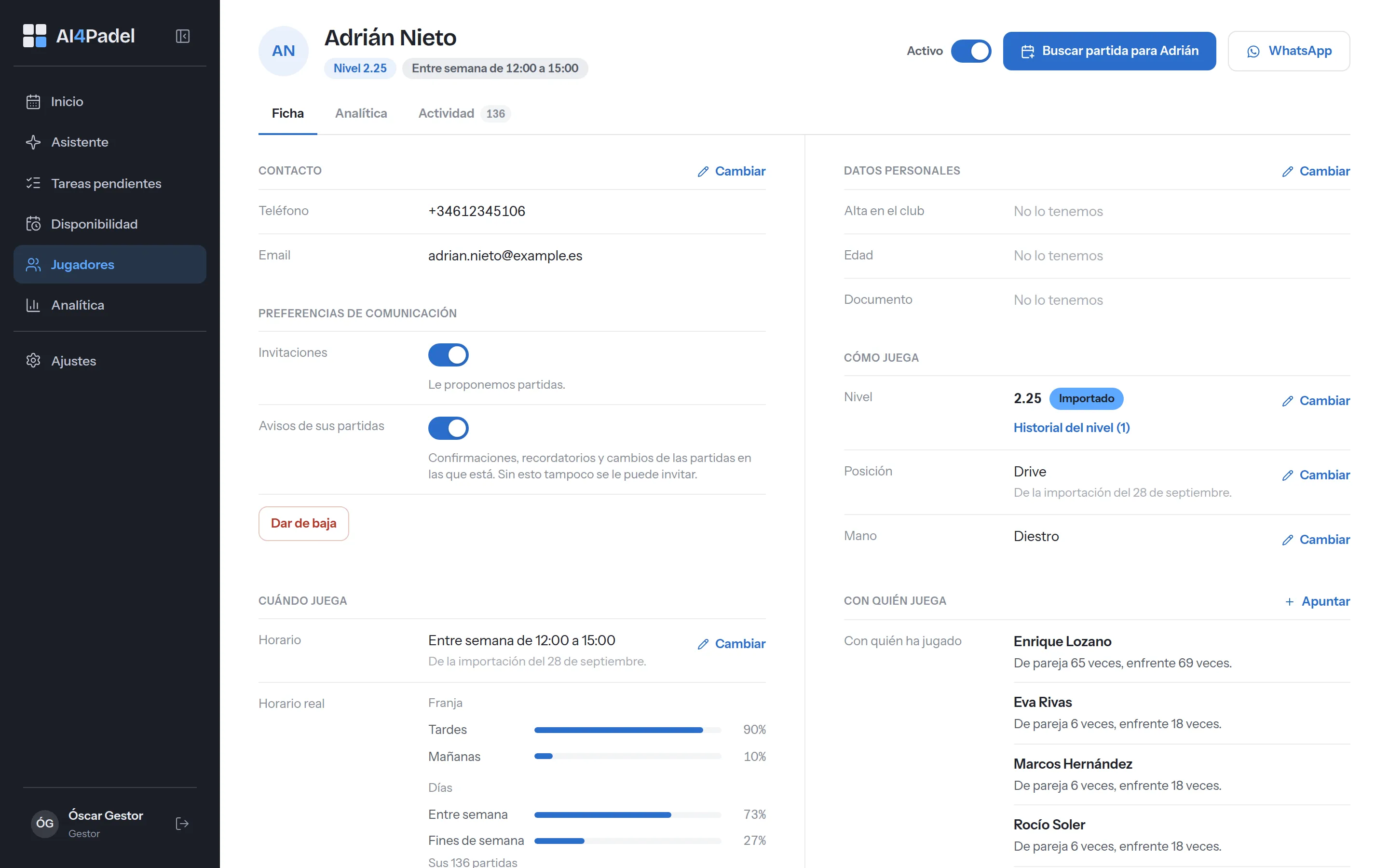
Adrián’s card in the demo club: level, hours, court side and hand, each with its source, and who he has played with.
Adrián’s card reads level 2.25, mornings. Below, when and how he plays, with its source: «De la importación el 22 de septiembre», from the import on 22 September. Also what only the club knows: who he likes to play with, who he’d rather not, and when he can’t.
And the Actividad tab tells you what he actually does:
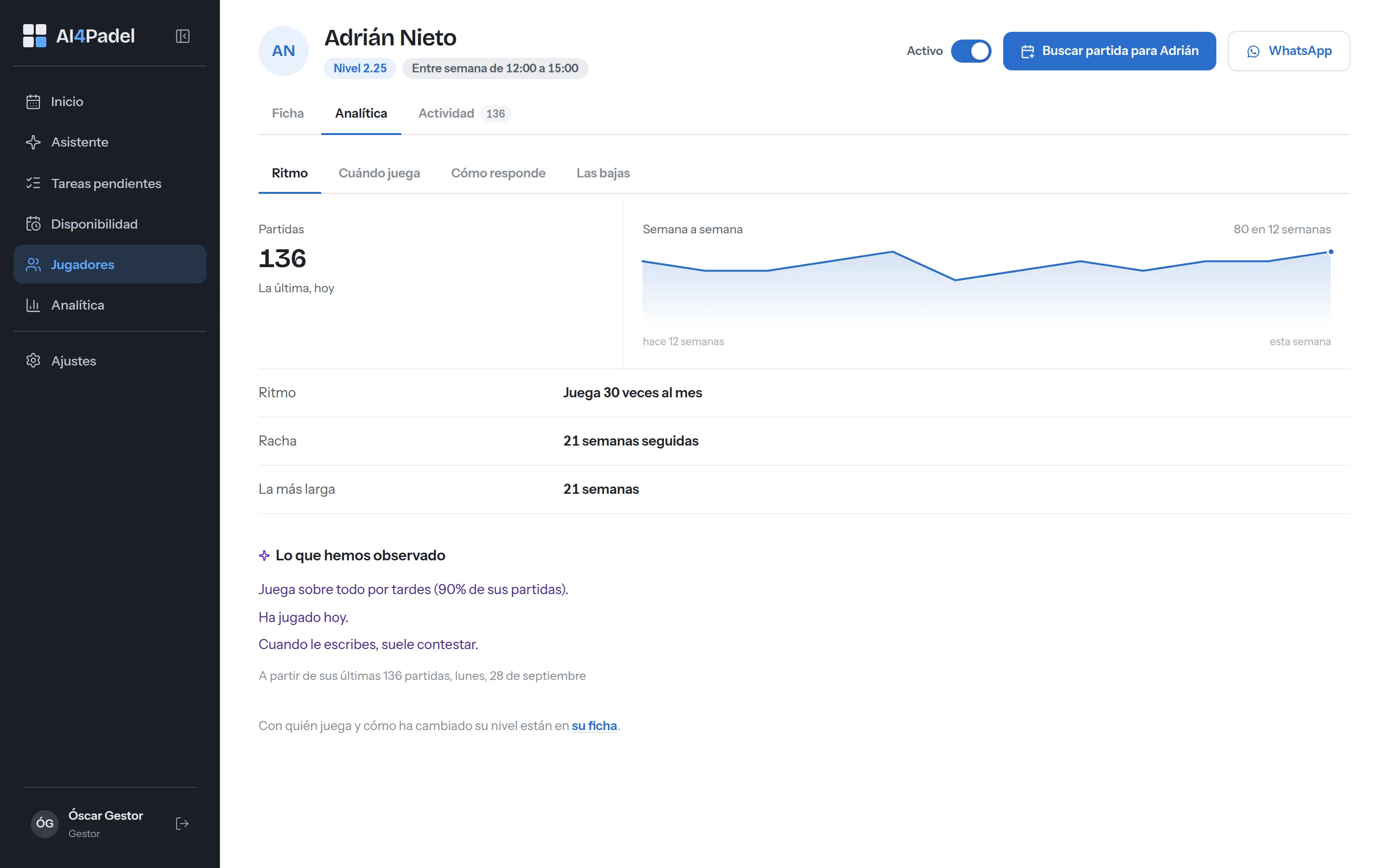
His card says weekdays from 12:00 to 15:00; his 136 matches say afternoons, 90 % of them.
136 matches, 30 a month and, under «Lo que hemos observado» (what we’ve noticed), «Juega sobre todo por tardes (90% de sus partidas)», mostly plays in the afternoon. The declared and the real, side by side, and the list draws on both.
Who never shows up
Two fixed absences, no exceptions:
- Anyone who asked not to be written to. You note it once and they are blocked, with no way to click past it. Their name enters no list.
- Anyone with no phone number on their card. Without a number there is no invitation to send, so they are never offered.
And it learns from what you note down
Every “yes” or “can’t” you note down and every match that gets played feed the player card: how many invitations they accept, when they really play, who with. The next list comes out of that data.
Want to see this screen with your real players instead of a demo club’s? Book a 15-minute demo and we’ll pull the list from your data: every name, with its why.